
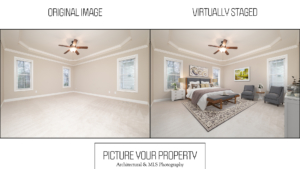
Virtual staging can help a buyer understand the scale and possible use of an empty room. It works best when the finished image is clearly labeled, the original photograph remains available, and the edit does not change the truth of the property.
Use furnishings to answer a practical question
An empty room can be difficult to read. Without familiar objects, a viewer may not know whether a bedroom comfortably supports a bed and side tables, whether a living area has a clear seating arrangement, or how an open space could be divided into dining and conversation zones. Representative furnishings give the eye a reference point.
That makes virtual staging especially useful when a vacant property is clean and well photographed but the purpose or scale of a room is not immediately obvious. A thoughtful treatment might add a sofa, chairs, rug, lamps, artwork, or a dining table that fits the visible space. The result should suggest one plausible use, not claim that the room is physically furnished or guarantee that a particular item will fit.
PyP’s Property Marketing Enhancements page shows the same room before and after disclosed virtual staging. The comparison is useful because the permanent room remains recognizable while the furnishings make a possible arrangement easier to imagine.
Separate presentation from alteration
Adding representative furnishings is different from changing permanent features or concealing conditions. Virtual staging should not be used to remove damage, replace flooring, change cabinetry, enlarge a window, invent a view, hide a structural element, or erase a condition that a viewer needs to understand. Those changes do more than illustrate possible use. They create a different account of the property.
The same distinction applies outdoors. A presentation enhancement should not manufacture a neighboring amenity, move a property line, remove a permanent obstruction, or imply completed work that does not exist. If a proposed renovation or unfinished construction needs to be visualized, that is a different kind of rendering and should be described as such.
Keep the original image in the story
The unstaged photograph is the clearest record of the room as it appeared when photographed. Keeping it alongside the virtually staged version lets buyers compare the actual condition with the suggested use. It also gives agents a flexible asset for platforms or audiences that need the original.
A practical sequence is to place the original and virtually staged images next to one another or close together, then use a direct label such as “Virtually Staged” on the edited image. The label should remain readable wherever the image is displayed. A caption alone may not travel with the image when it is syndicated, downloaded, or shared.
MLS requirements are not identical everywhere and can change. National policy gives local MLS organizations discretion over submitted property images, and specific systems may impose their own labeling, original-image, ordering, or display requirements. Agents should confirm the current rules of the listing’s MLS and brokerage before publishing. For example, current Canopy MLS guidance requires a clear disclosure on virtually staged images and an original image immediately before, after, or otherwise readily accessible. That example should not be assumed to describe every MLS.
Build a clear review process
Before approving a virtually staged image, compare it directly with the original and ask:
- Do the walls, windows, doors, flooring, fixtures, and other permanent features remain accurate?
- Are any visible conditions being concealed or minimized by the added furnishings?
- Does the furniture scale look plausible for the room?
- Is the edited image clearly and durably labeled?
- Is the original photograph included where the applicable MLS and campaign require it?
Reviewing the pair together catches confusion before the images reach a listing portal or social channel. It also helps keep the agent, seller, and media team aligned on what the enhancement is meant to communicate.
Choose virtual staging when it adds understanding
Virtual staging is not necessary for every empty room. Some spaces are already easy to understand from strong photography, and too many staged variations can make a listing feel less consistent. Use it where furniture provides a meaningful scale reference or clarifies a room whose purpose is otherwise ambiguous.
The goal is a more understandable presentation, not a more fictional property. Keep the source photograph, disclose the treatment, and verify the rules that apply to the listing before publication.
See the disclosed comparison in PyP’s virtual-staging work, then order listing media when the property would benefit from the same clear before-and-after approach.